20 vs 40 vs 60 Mesh: What Each Strainer Size Actually Catches
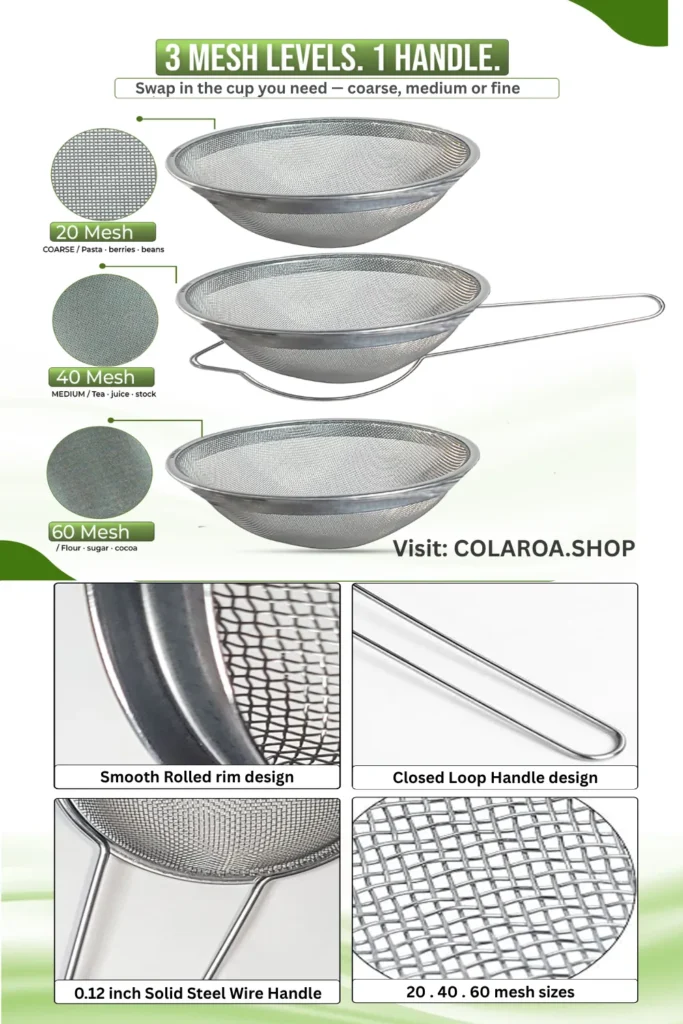
The short answer: mesh numbers count the wires per inch. 20 mesh is coarse and holds back pasta, beans and berries while water rushes through. 40 mesh is the everyday middle ground for tea, juice and stock. 60 mesh is fine enough to sift flour, dust cocoa and strain nut milk. If you only remember one rule: the bigger the number, the finer the net.
What the numbers mean
A “20 mesh” screen has 20 wires per inch in each direction, leaving openings of 0.86 mm. At 40 mesh the openings shrink to 0.38 mm, and at 60 mesh to about 0.23-0.25 mm – smaller than a grain of table salt. That’s why the same tool behaves so differently depending on the cup you fit.
Quick reference table
| Mesh | Opening (approx.) | Best for | Too fine for |
|---|---|---|---|
| 20 (coarse) | 0.86 mm | Rinsing rice, quinoa, beans, berries; draining pasta | Sifting flour |
| 40 (medium) | 0.38 mm | Loose-leaf tea, juice, gravy, stock, couscous | Nut milk |
| 60 (fine) | 0.23-0.25 mm | Flour, powdered sugar, cocoa, nut milk, cold brew, custards | Nothing in a home kitchen – this is the finest you need |
Manufacturer specifications
Exact figures for the three COLAROA mesh cups, confirmed by our manufacturer:
| Spec | 20 mesh | 40 mesh | 60 mesh |
|---|---|---|---|
| Openings per linear inch | 20 | 40 | 60 |
| Hole opening size | 0.034 in / 0.864 mm (864 microns) | 0.015 in / 0.381 mm (381 microns) | 0.009-0.010 in / 0.229-0.250 mm (229-250 microns) |
| Wire thickness | 0.014 in / 0.355 mm | 0.010 in / 0.254 mm | 0.0063 in / 0.160 mm |
Why one size never fits all
Use a fine mesh for rice and it clogs with starch; use a coarse mesh for cocoa and everything falls straight through. That mismatch is why kitchens end up with a drawer full of single-purpose strainers. A three-cup system – one handle, cups in 20, 40 and 60 mesh – covers the whole range in one drawer slot.
The COLAROA way
COLAROA is a 3-in-1 fine mesh strainer set: one solid 304 stainless steel handle and three swap-in mesh cups (20, 40, 60). The cup spring-fits into the handle frame – no weld between handle and cup, so the joint that snaps on ordinary strainers doesn’t exist. More answers on our FAQ page, and if you want 15% off when we launch on Amazon, join the launch list.