Why Strainer Handles Break (It’s Almost Always the Weld)
The short answer: nearly every kitchen strainer is built the same way – a wire handle spot-welded to the rim of the mesh bowl. Heat, water, detergent and a few hundred lifting cycles slowly fatigue those two tiny weld points until one day the bowl simply drops off the handle, usually over a pot of boiling pasta.
Read the one-star reviews
Open the reviews of any bestselling strainer and sort by lowest rating. The same story repeats: “handle snapped off”, “bowl separated after two months”, “weld broke the first time I drained potatoes.” It isn’t bad luck – it’s the design. A spot weld is a tiny bridge of melted metal, and every hot-cold cycle in the dishwasher expands and shrinks it a little differently than the steel around it. Metal fatigue does the rest.
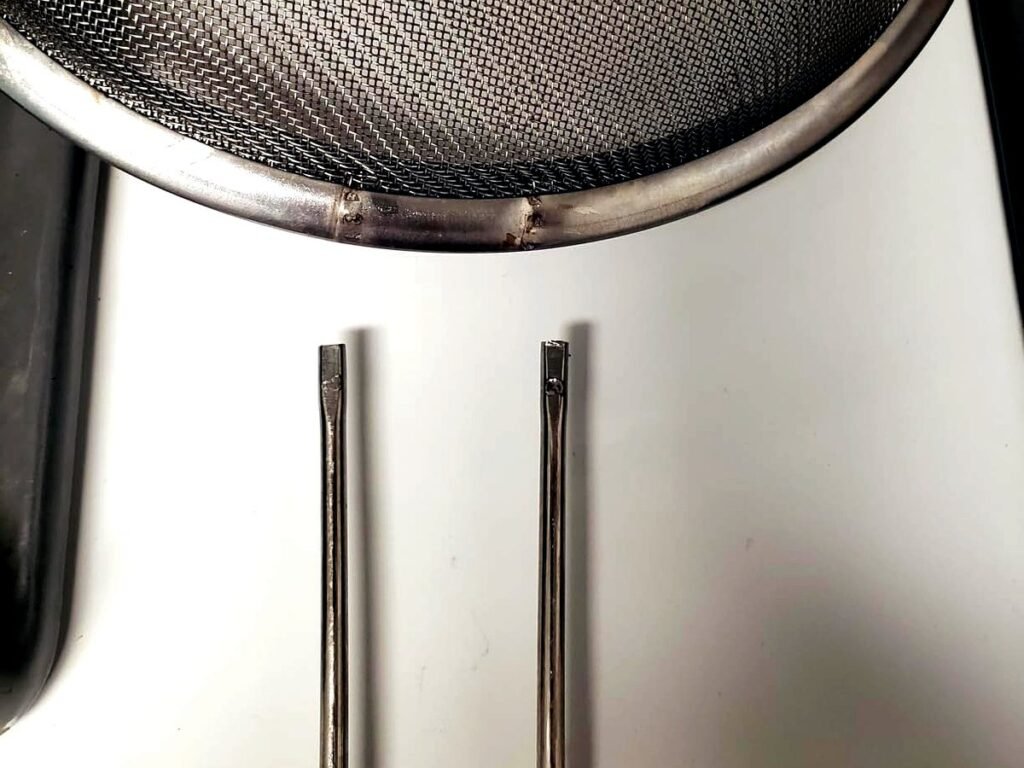
The two tiny spot welds that held this handle – until they did not.
Why welds fail in the kitchen
Three stresses gang up on that joint: leverage (a full strainer multiplies force at the rim), thermal shock (boiling water then cold rinse), and corrosion (weld spots are the least protected part of stainless steel). Any one of them is manageable. All three, daily, is why the handle joint is almost always the first thing to fail.
The fix: remove the weld from the equation
You can’t make a spot weld immortal – but you can design the joint out entirely. COLAROA’s mesh cup is never welded to the handle. The cup spring-fits into a solid 3 mm 304 stainless wire frame: press it in to seat it, flex the frame slightly to release it. The joint that breaks on ordinary strainers simply does not exist, and you get three mesh grades (20, 40, 60) on one handle as a bonus.
Curious how the swap works? It’s covered on the FAQ page. And if your current strainer is living on borrowed time, join the launch list – everyone on it gets 15% off during launch week on Amazon.